What a temporary email actually is
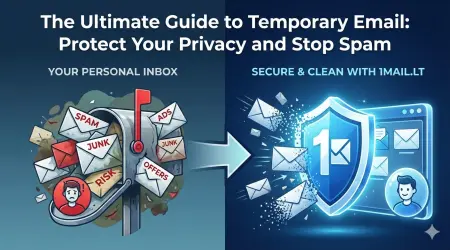
A temporary email — also called a disposable, throwaway or burner inbox — is a real, working email address that you use once and then forget. You do not sign up, you do not pick a password, and you do not hand over your personal Gmail. You open a page, an address is already waiting for you, and any message sent to it (a confirmation link, a verification code, a download) lands in a public-to-you inbox within seconds. When you close the tab, that inbox is gone.
The point is simple: most of the places that demand your email address do not actually need your address. They need an address that can receive one message. A temporary inbox gives them exactly that and nothing more — no marketing list, no data to leak, no password to reuse.
How it works, briefly
Behind the scenes, a temporary-email service owns a set of domains and runs a mail server that accepts everything sent to them. When you visit the site, it assigns you a random address on one of those domains and shows you that mailbox live. There is no account because the address itself is the only credential — whoever is looking at that inbox in the browser is the "owner" for as long as it exists. That is also the one thing to keep in mind: a disposable inbox is convenient precisely because it is not locked down, so it is meant for throwaway sign-ups, not for anything you need to keep.
When a temporary email is the right choice
Reach for a disposable inbox whenever the value you get is a one-time thing and the ongoing relationship is not worth your real address:
- Downloading a "free" file behind an email wall — the whitepaper, the wallpaper pack, the coupon. You want the link, not the newsletter.
- Reading content that demands registration — forums, one-off articles, Wi-Fi captive portals.
- Trying a product you are not sure about — spin up a throwaway inbox, take the free trial, decide later whether it earns your real address.
- Signing up for services you will not need to recover — casual accounts on gaming stores, dating apps and streaming trials are common examples. We have step-by-step walk-throughs for many of these, like using a temp email for Plenty of Fish or for GOG.
- Keeping your primary inbox clean — every address you never give out is spam you never receive.
If that is what you need right now, you can grab a free temporary inbox on the homepage — it is ready before you finish reading this sentence.
When you should NOT use one
Being honest about the limits is what keeps you out of trouble. Skip the disposable inbox when you will need the account again:
- Anything tied to money. Banking, PayPal, crypto exchanges — these need password resets and security notices you must actually receive. We spell this out in our guide on temp mail and PayPal: it is the wrong tool for a payment account.
- Accounts you will want to recover. If losing access would hurt (your main social profile, work tools, a subscription you pay for), use an address you control.
- Two-factor and security codes for important logins. A public inbox is fine for a one-off verification, but not as the permanent recovery address for something valuable.
- Anywhere it breaks the rules. Some platforms prohibit disposable addresses; respect their terms.
The rule of thumb: if you would be upset to lose the account, do not use a throwaway inbox for it.
How to use a temporary email safely
- Open a fresh inbox and copy the address you are given.
- Paste it into the sign-up form on the site you are using.
- Come back to the inbox and wait a few seconds — the verification email or code appears on its own.
- Click the link or copy the code, finish your sign-up, and you are done.
- If you think you will need that same inbox again in an hour, keep the tab open, or use a service that lets you keep the address longer.
That last point is the one people miss: a standard disposable inbox is deliberately short-lived. If you want the convenience of a burner address but need it to survive for days — and to keep the messages — that is exactly what a paid tier is for. Our Pro plan keeps messages for 30 days, removes ads, and lets you use custom domains, while everyday one-off sign-ups stay completely free.
Temporary email vs the alternatives
A disposable inbox is not the only way to protect your real address. It is the fastest, but here is how it compares:
- Temporary email: instant, no account, perfect for one-time sign-ups. Trade-off: not meant for anything you must keep.
- An email alias (a forwarding address that lands in your real inbox): good when you do want the messages long-term but still want to hide your real address and be able to switch it off later. More setup than a throwaway.
- A separate "spam" Gmail: works, but it is a real account you have to create, secure and check — the opposite of throwaway.
Most people end up using a mix: a disposable inbox for the endless one-off sign-ups, and an alias for the handful of services they actually care about.
Frequently asked questions
Is using a temporary email legal? Yes. Choosing not to hand a website your personal address is your right. What matters is what you do with the account, not the address you used to open it.
Can I reply to messages from a temporary inbox? Most disposable inboxes are receive-only — ideal for verification codes and links, not for holding a conversation.
How long does the address last? On a free throwaway inbox, usually until you close it or after a short window. If you need it to last, that is where a paid tier with longer retention comes in.
Is it private if the inbox is public? The address is random and unguessable, so in practice only you are looking at it — but treat it as throwaway, never as a vault. Never send anything sensitive to a disposable inbox.
The bottom line
A temporary email is the right tool for the huge category of sign-ups that do not deserve your real address: downloads, trials, forums, casual accounts. Use it freely there, keep it away from anything tied to money or anything you will need to recover, and reach for an alias or a paid inbox when you actually want to keep the messages. Used that way, a disposable inbox is one of the simplest privacy upgrades you can make — and you can start with a free one right now.