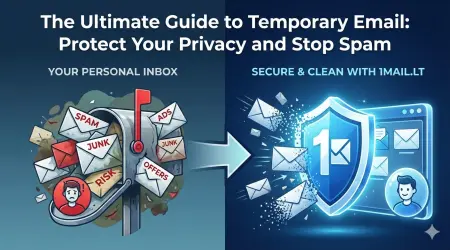
Shopee is worth an account even when you are not buying much: following a seller, watching a price, or comparing a listing against the same item elsewhere all work better signed in. The cost arrives afterwards, as flash sale reminders, coin drops, voucher alerts and live stream notifications. None of it is malicious. All of it lands in the same inbox as your bank and your employer.
A disposable address separates the two in about thirty seconds. Open a temporary inbox that needs no registration of its own, use that address to sign up, catch the confirmation message, and every campaign email afterwards goes somewhere you never have to open. Below is the process, the phone verification step, and an honest explanation of when this is the wrong idea.
When a disposable address is the right tool
It fits situations where the account itself is disposable:
- Browsing and price watching. You want the catalogue and the wishlist, not a relationship with the marketing team.
- Comparison shopping. Checking a price here against another marketplace before deciding where to buy.
- Looking at another country's storefront. Regional catalogues differ, and so do prices.
- Protecting an address you actually read. Once an address is in a promotional database, it stays there.
The general case for keeping a throwaway identity for low-stakes signups is laid out in the benefits of a temporary disposable email, and it applies to any marketplace.
Signing up, step by step
- Open the temporary inbox first. An address is generated immediately. Copy it and leave the tab open, because that tab is how you read the confirmation.
- Go to Shopee's signup page or app for your country. Accounts are regional, so pick the storefront you want to shop from.
- Enter the temporary address where the form asks for email, and set a password you have never used anywhere else.
- Switch back to the inbox tab. The verification message usually arrives within seconds. Open it and click the link or copy the code into the form.
- Finish the profile and you are in, with promotional mail pointed at an address that expires on its own.
Two notes. Do not close the inbox tab until verification is complete, because a temporary address is only useful while the inbox behind it is alive. And write the address down if you expect to need it again, for instance to update the account later.
The phone number and OTP step
Shopee usually asks for a mobile number too, either during registration or the first time you do something involving money or delivery. It sends a one-time code by SMS and expects you to type it back, which confirms two things: that the number is real, and that you are holding the device it belongs to.
This is standard practice across marketplaces, and how SMS verification works explains the mechanics and its weaknesses. If you want to see the flow before committing your own number, there are publicly listed numbers that display incoming SMS, which are useful for testing and for signups you genuinely do not care about.
Be clear-eyed about them. Those numbers are public, so anyone can read the codes sent to them, which makes them unsuitable for any account holding money, orders or personal details. Many services also detect and refuse shared numbers, which is entirely their right. Verification exists for a reason and this is not a way around it. For a real account, use your real number.
Where a throwaway address is the wrong choice
The moment the account holds something you would miss, the calculation flips. That means anything with real orders, saved payment methods, a wallet balance, a shipping address, an ongoing refund or dispute, and above all a seller account with payouts attached.
The reason is recovery, not policy. Password resets go to the registered email. When a temporary inbox expires, that route disappears, and so does access to an account that may hold money or an order history you need. Support processes also lean on the registered address to confirm who you are.
There is a quieter second problem: transactional mail. Order confirmations, tracking updates, refund correspondence and dispute evidence all arrive by email, and those are exactly the messages you want to search months later. A disposable inbox is designed to forget them.
A better setup for an account you plan to keep
Use a real address you control. If your provider supports aliases or plus-addressing, make a dedicated one for shopping so you can filter it and, if it leaks, see where the leak came from.
Then protect it properly. A long passphrase you have never reused beats a short complicated password, and you can generate one that is actually memorable in seconds. Add two-factor authentication wherever it is offered, preferring app-generated codes over SMS, since app codes cannot be intercepted by a SIM swap. A browser-based authenticator for the six-digit codes works if you would rather not install another app, though for an account tied to payments a dedicated device app is sturdier.
Turning down the marketing flood
If you keep an account on your real address, you can quiet it without abandoning it:
- Go through the notification settings in the app. Email, push and SMS marketing are usually separate toggles, and turning off push does nothing to the email.
- Use the unsubscribe link at the bottom of promotional mail. On a legitimate platform this works, and it is faster than hunting through menus.
- Expect transactional mail to continue. Order and delivery updates are not marketing and cannot be switched off.
- Filter rather than delete. A rule that files anything from the marketplace into its own folder keeps the inbox clean while leaving receipts searchable.
A note on where Shopee operates
Shopee is run by Sea Limited, is headquartered in Singapore, and is one of the largest e-commerce platforms across Southeast Asia, including Singapore, Malaysia, Indonesia, Thailand, Vietnam, the Philippines and Taiwan. It also operates in Brazil, where it has become a significant marketplace.
Storefronts are regional. Sellers, currency, shipping options and campaigns differ by country, and an account created for one region does not automatically serve another. If you are curious about a catalogue outside your own country rather than planning to buy from it, that is a reasonable use for a disposable address.
FAQ
Will Shopee accept a temporary email address?
Signups with a disposable address usually work like any other, but some platforms keep lists of known throwaway domains and reject them. That is their decision. If the form refuses your address, use a real one.
Can I change the registered email later?
Account settings generally allow updating the email, with verification sent to the new address. If you decide to keep an account you created with a temporary address, do the swap while the temporary inbox is still alive.
Do I still need to give a phone number?
For anything beyond basic browsing, yes. Checkout, delivery and wallet features rely on a verified number, and a disposable email does not change that requirement.
What happens when the temporary inbox expires?
Messages sent to that address stop being readable and password recovery goes with them. If the account holds nothing you care about, that is the intended outcome. If it does, move it to a real address first.
Is any of this against the rules?
Registering with an address you control is ordinary, and you remain responsible for keeping access to it. Shopee's terms, verification requirements and rules on duplicate accounts still apply exactly as written, and a temporary address is not a way around any of them.
If the account is just for browsing and price watching, start it on a temporary inbox and keep the campaign mail away from the address you actually read.